




2025 Chevrolet Blazer near Morganton, NC
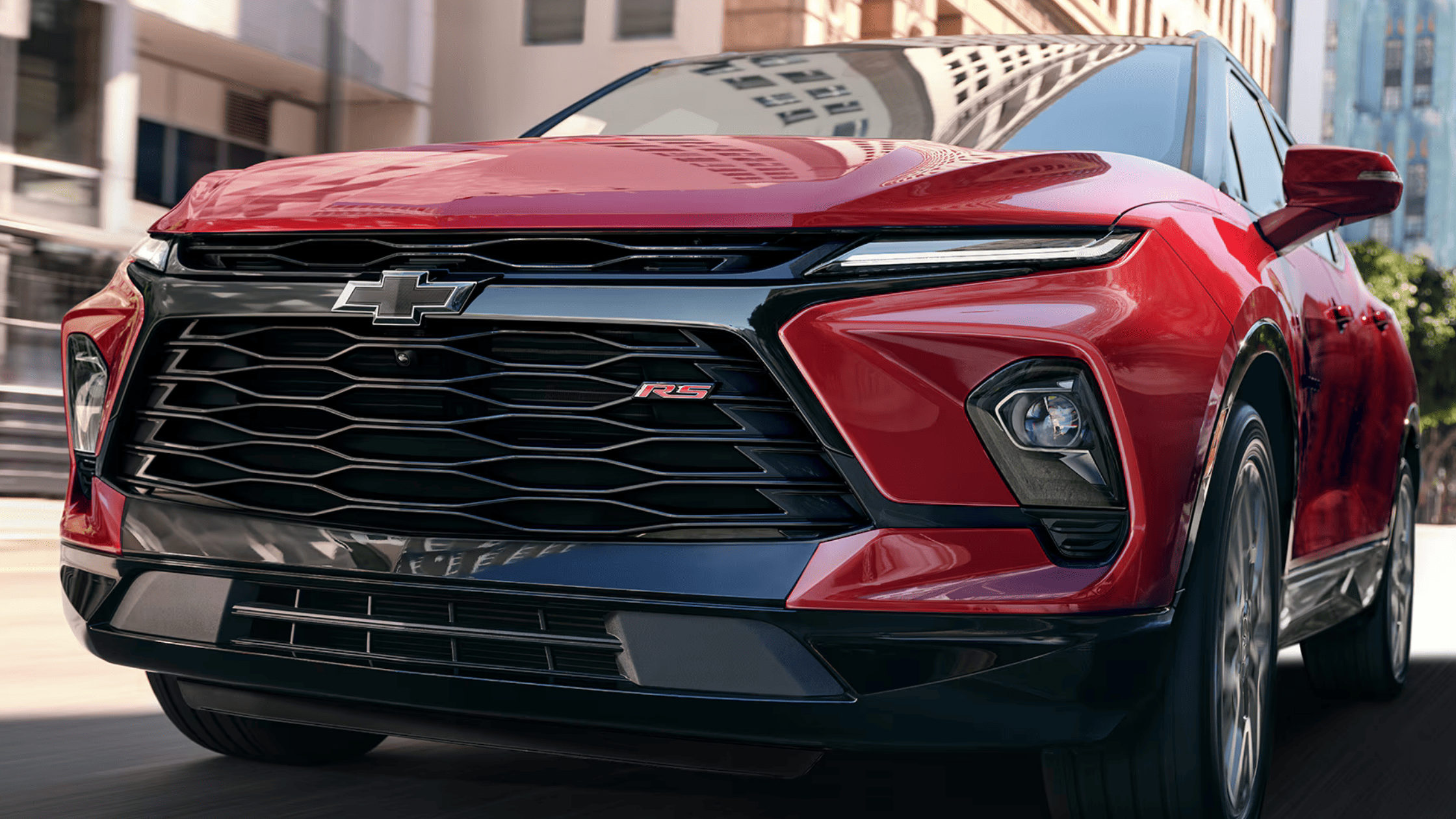
The 2025 Chevrolet Blazer introduces performance upgrades and specification enhancements across its trims. With two advanced engine configurations, refined suspension systems, optimized aerodynamics, and a standard suite of safety technologies, the 2025 Chevrolet Blazer supports daily operation and utility-focused use. The vehicle's internal and external dimensions, curb weight variation, and integrated technology systems further underscore its capability in a highly competitive segment.

Interior Space and Cabin Configuration
The 2025 Chevrolet Blazer supports five-passenger seating with a total EPA passenger volume of 107.8 cubic feet. Front seat headroom measures 39.8 inches without a sunroof and 38.0 inches with a sunroof. Rear headroom measures 38.6 inches without a sunroof and 36.8 inches with a sunroof.
Front legroom is 41 inches, and rear legroom is 39.6 inches. Shoulder room at the front is 59.1 inches and 58.6 inches at the rear. Hip room is measured at 55.6 inches in the front and 54.2 inches in the rear.
Curb Weight and Cargo Flexibility
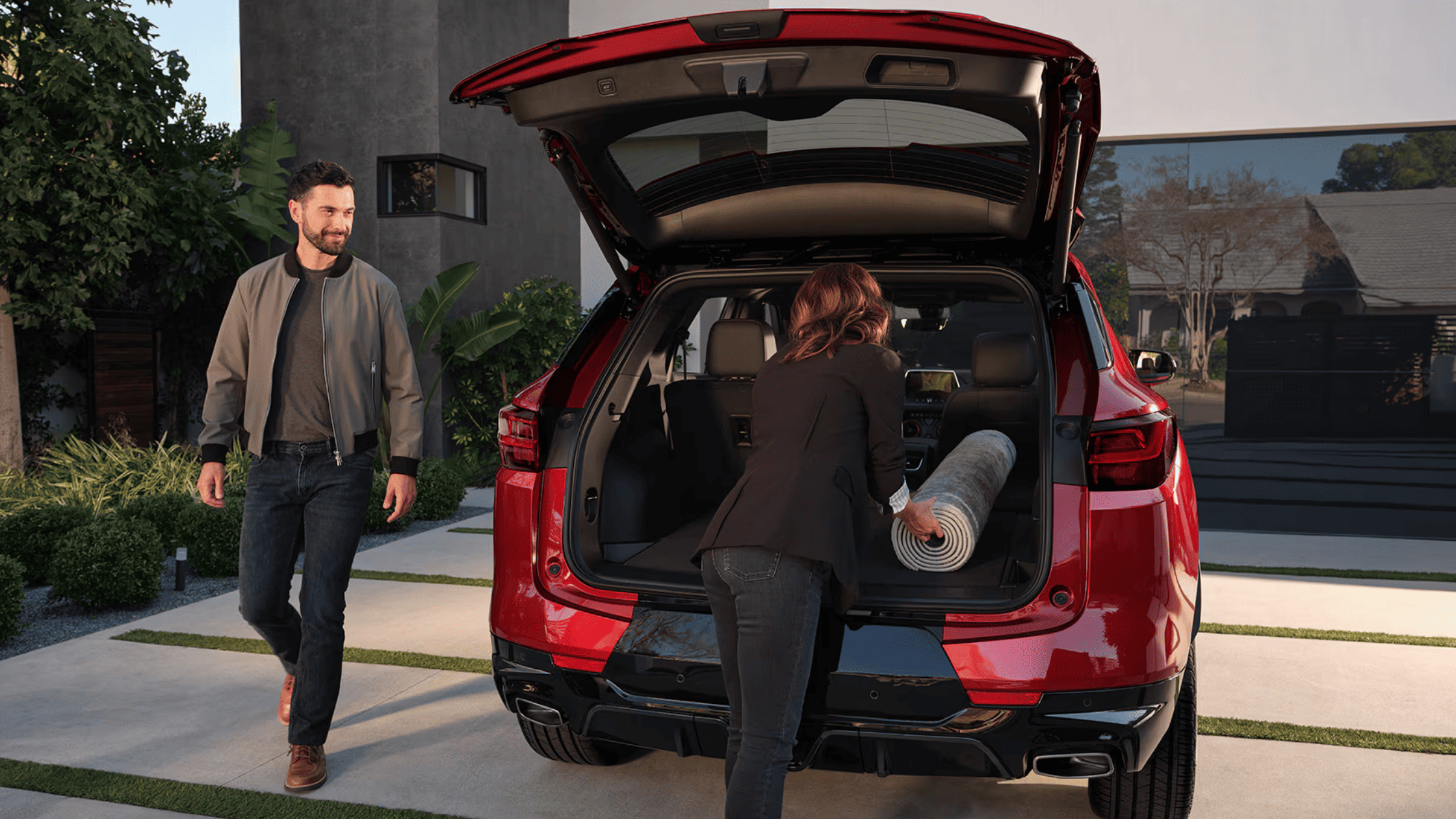
Curb weights vary by configuration. The lightest variant is the LT trim with the 2.0L turbocharged engine and front-wheel drive at 3,918 lbs. The heaviest configuration is the Premier trim with the 3.6L V6 and all-wheel drive at 4,322 lbs. Max cargo capacity behind the rear seat is 30.5 cubic feet, increasing to 64.2 cubic feet with the rear seat folded.
Turbocharged and Naturally Aspirated Powertrain Variants
The 2025 Chevrolet Blazer is available with a 2.0L turbocharged inline-four or a 3.6L V6 engine. The 2.0L engine is constructed from high-pressure die-cast aluminum with cast-in-place liners. The engine utilizes a dual overhead camshaft configuration and a tripower system for variable valve operation. Fuel delivery is managed through a direct, high-pressure injection system paired with electronic throttle control. This engine produces 228 horsepower at 5,000 rpm and 258 lb.-ft. of torque between 1,500 and 4,000 rpm.
The 3.6L V6 is built with a cast aluminum block and cast-in-place iron bore liners. Like the 2.0L, it employs a dual overhead camshaft system, with four valves per cylinder and continuously variable valve timing. The V6 generates 308 horsepower at 6,700 rpm and 270 lb.-ft. of torque at 5,000 rpm. Both engines incorporate automatic stop/start systems for efficiency in idle conditions.
Transmission Calibration and Gear Progression
Each engine is paired with a dedicated Hydra-Matic nine-speed automatic transmission. The 2.0L is matched with the 9T60 model, while the 3.6L is paired with the 9T65. Both transmissions share identical gear ratios across all nine forward gears and reverse. These include a first gear ratio of 4.69, second at 3.31, third at 3.01, and progressing down to 0.62 in ninth gear. Reverse is 2.96. The final drive ratio differs slightly, with the 2.0L variant at 3.47 and the 3.6L variant at 3.49, providing a slightly different torque delivery profile suited to each engine's powerband.
Chassis Dynamics and Ride Control Systems
The ride and handling characteristics of the 2025 Chevrolet Blazer are managed through an independent MacPherson® strut front suspension, which includes a hydraulic control arm ride bushing and hollow stabilizer bar. The rear suspension consists of a five-link independent layout, also equipped with a hollow stabilizer bar. This configuration is designed to deliver a consistent response across uneven surfaces.
The steering system is an electric variable-effort setup that includes Active Return Assist, which helps realign the steering wheel during vehicle exit from a turn. The turning circle is 38.7 feet, supporting maneuverability in confined spaces. Braking systems include four-wheel disc brakes with a variable brake system, low-drag calipers, and Duralife rotors. Rotor dimensions are 12.64 inches at the front and 12.40 inches at the rear.
External Dimensions and Wheel Options
Overall dimensions for the 2025 Chevrolet Blazer include a wheelbase of 112.7 inches, an overall length of 191.8 inches, a width of 76.7 inches, and a height of 67 inches. The track width is 66.4 inches at the front and 66.2 inches at the rear.
Wheel sizes include 18-inch aluminum wheels as standard on the LT trim. The RS and Premier trims feature standard 20-inch aluminum wheels, with an available 21-inch option. Tire specifications include P235/65R18, P235/55R20, and P265/45R21 all-season variants. These combinations contribute to road stability and optimized ride quality.
Trailer Ratings and Load Support
Trailering capacity is contingent upon the engine and equipment. For both engine types without a trailering package, maximum towing capacity is 1,500 lbs. With the optional trailering package, the 2.0L engine supports up to 3,250 lbs, while the 3.6L engine increases towing capacity to 4,500 lbs with either front- or all-wheel drive. These ratings are dependent on passenger load, cargo distribution, and installed options.
Integrated Safety Framework and Assistive Technologies
Standard safety features include multiple airbags. The frontal and seat-mounted side-impact airbags for the driver and front passenger, a driver knee airbag, and head-curtain airbags for both rows of seating. The vehicle also includes a Passenger Sensing System and Tire Pressure Monitoring with Tire Fill Alert.
The Chevy Safety Assist system is standard and includes Automatic Emergency Braking, Forward Collision Alert, Lane Keep Assist with Lane Departure Warning, Front Pedestrian Braking, Following Distance Indicator, and IntelliBeam® high beams. A standard HD Rear Vision Camera supports parking and reverse maneuvers.
An optional Driver Confidence II Package is available for RS and Premier trims. It includes HD Surround Vision, Rear Camera Mirror, Adaptive Cruise Control, Enhanced Automatic Emergency Braking, and a Safety Alert Seat. These features contribute to awareness and driver support under changing road conditions.
Technology and Operational Interfaces
While the specification document does not detail the entire infotainment suite, the 2025 Chevrolet Blazer includes wireless device charging for compatible mobile devices. System compatibility varies by phone model and may require additional accessories. Drivers are encouraged to verify support through the Chevrolet guidance resources.
Adaptive Cruise Control and Enhanced Automatic Emergency Braking are available across all trims, offering speed and gap management functions. These systems are supplemental and do not replace attentive driving or full control by the operator.
Exterior Customization and Trim Design
The model year introduces a new Habanero Orange exterior finish. The Redline Edition, previously available only with select colors, can now be paired with the Iridescent Pearl Tricoat. These updates allow for trim-specific configurations based on customer preference.
Fuel Efficiency and Tank Capacity
Fuel economy varies by engine and drivetrain. The 2.0L turbocharged engine achieves up to 22 mpg city and 29 mpg highway in FWD configurations. AWD versions deliver 22 mpg city and 27 mpg highway. The 3.6L V6 offers 19 mpg city and 26 mpg highway with FWD and 18 mpg city with the same 26 mpg highway for AWD.
Fuel tank capacity is approximately 19.4 gallons for front-wheel-drive models and 21.7 gallons for all-wheel-drive variants. These figures contribute to consistent range planning for both urban and longer-distance use.
Disclaimer: EPA estimate for FWD and 2.0L Turbo engine. EPA estimated 19 MPG city/26 highway for FWD and 3.6L V6 engine as shown.
Schedule a Test Drive Today
The 2025 Chevrolet Blazer delivers engine versatility, nine-speed automatic precision, and integrated driver-assistance systems. With standard safety features and adaptive cruise technologies, it supports confident operation. The model’s cargo configuration, towing readiness, and technical efficiency make it suitable for functional day-to-day transport. To evaluate performance and handling in person, schedule a test drive of the 2025 Chevrolet Blazer at Elevation Chevrolet GMC near Morganton, NC.